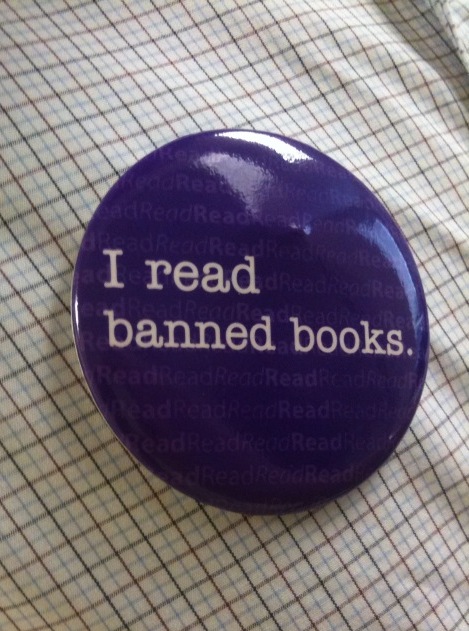
 Signs posted across the Queens University of Charlotte campus this week read, “The following books have been banned until further notice,” listing classic titles in literature: Lee’s To Kill A Mockingbird, Bradbury’s Fahrenheit 451, Paterson’s Bridge to Terabithia, and Salinger’s Catcher in the Rye, to name a few.
On Wednesday, faculty, staff, and students from all departments, majors, and offices gathered to read and reflect on these works and their role in a society which values the freedom of expression.
Every fifteen minutes for 7 hours, a new banned title was chosen and the oration began anew. The sounds and syllables of Sylvia Plath, Toni Morrison, and Harper Lee filled the hallways of Trexler Student Center amidst the usual noise of the venue. And from time to time, students, diners, or passers-by stopped to listen and to wonder, “Who would want to ban a book? And why?”
Without prompting, students, like those in my Media Aesthetics class, pondered aloud the merits of censorship, propriety and choice — in books, movies, and digital media forms. In our unexpected classroom discussion, one student suggested that censorship and secrecy had no place in American society, while another posited that, from time to time, such action might serve the common good.
For my part, I led a discussion on liberties when it naturally arose in class. And I spent my fifteen minutes reading from 1984, by George Orwell:
The process of continuous alteration was applied not only to newspapers, but to books, periodicals, sounds tracks, cartoons, photographs — to every kind of literature or documentation which might hold any political or ideological significance. Day by day and almost minute by minute the past was brought up to date … nor was any item of news, or any expression of opinion, which conflicted with the needs of the moment, ever allowed to remain on record. All history was a palimpsest, scraped clean and reinscribed as often as was necessary. (chapter 1, section IV, para. 7)
In the meantime, critical thinking flourished. Citizenship was pondered. And the American freedoms of speech, press, religion, assembly, and petition were debated and affirmed. All because some communication majors, some faculty members, some staff members and some librarians decided it would be a good idea to read books.

Note: Queens University of Charlotte did not ban books. The Knight School of Communication, the Everett Library, and Lambda Pi Eta National Honor Society collaborated to support the American Library Association’s (ALA) Banned Book Week, September 25-October 2, 2010. According to the ALA website, events held during Banned Books Week “highlight the benefits of free and open access to information while drawing attention to the harms of censorship by spotlighting actual or attempted bannings of books across the United States.”


 J.A.McArthur
Leave a reply to BLOG COMMENTS « Brittany's Blog Cancel reply