Proxemics
Posts related to the study of proxemics: how space is used by (and uses) us.
-

“Out of the Mountain of Despair, a Stone of Hope”
As I entered the Martin Luther King, Jr. Memorial in Washington, DC this week, I marched through the mountain of despair. Looking through the gap, all I saw was the east, the water, the promise of life greater than myself. I can only imagine that this was the designer’s intent: that we would walk through the mountain…
-

Harness the Power of Learning Spaces
Classroom space should work for us, not against us. As the evolution of classroom space continues, many professors find themselves working in innovative environments like studios, computer labs, and modifiable classrooms. To effectively facilitate learning in such spaces, teachers must harness the power of the space instead of being paralyzed by it. At Queens University…
-

Popular Music meets Digital Subcultures
“Digital Subculture: A geek meaning of style” was selected as a chapter for the Sage Benchmarks in Culture and Society reference text, Popular Music. The research article — originally published in the Journal of Communication Inquiry — was an argument that subcultures could gather in digital spaces the same way that they convened in coffee houses and…
-

Offices Don’t Need Walls
On my commute this morning, I noticed the most curious of offices. Naturally, I photographed and tweeted my haphazard discovery: Offices. Increasingly mobile and no longer constrained by walls: http://twitpic.com/3r6q86 — John A. McArthur (@JAMcArthur) January 18, 2011 The result of my single, innocent tweet has been a backlash of comments about the cultural and sociological…
-

Language and Social Interaction in CMC
Scholars in language and social interaction study face-to-face, oral conversations. However, some are turning their attention toward Internet-based conversation. In this panel, entitled, “Language & Social Interaction Research into Internet-Mediated Communication,” presenters discussed the relationship between language, social interaction, and conversations on the Internet. The major question here is whether (1) the medium drives the…
-

Diana, Queen of the Inanimate Twitterverse
Amidst elements that threaten to oxidize, cleanse, sear and scar, the bronze statue of Young Diana nobly stands, keeping watch over those who pass her by. Cast by renowned sculptor Anna Hyatt Huntington in 1924, the bronze was a gift to the university from the artist herself in 1940. This year, Diana celebrates her seventieth…
-

Mediated Group Communication
Queens University of Charlotte Media Release March 31, 2010 Dr. John A. McArthur, assistant professor in the School of Communication, wrote a book chapter that was published in the recently released text “Interpersonal Relations and Social Patterns in Communication Technologies: Discourse Norms, Language Structures and Cultural Variables.” The book, edited by Dr. Jung-Ran Park and Dr.…
-
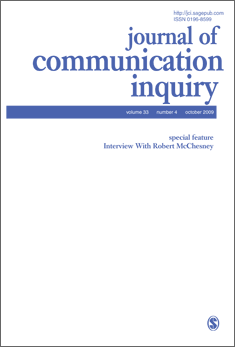
Can Groups Successfully Gather in Digital Space?
Queens University of Charlotte Media Release February 12, 2009 Dr. John A. McArthur, Assistant Professor in the School of Communication, had an article published in the January 2009 issue of the Journal of Communication Inquiry. The article, titled “Digital Subculture: A geek meaning of style” investigated groups in Internet-based chat rooms to assess indicators of…
-
Queens Professor featured at NCA
Queens University of Charlotte Media Release November 24, 2008 Dr. John A. McArthur, Assistant Professor in the School of Communication, presented his research during a featured panel at the annual conference of the National Communication Association in San Diego, CA, Nov. 21-24, 2008. His paper, Instructional Proxemics: Making a case for the study of space…
 J.A.McArthur